

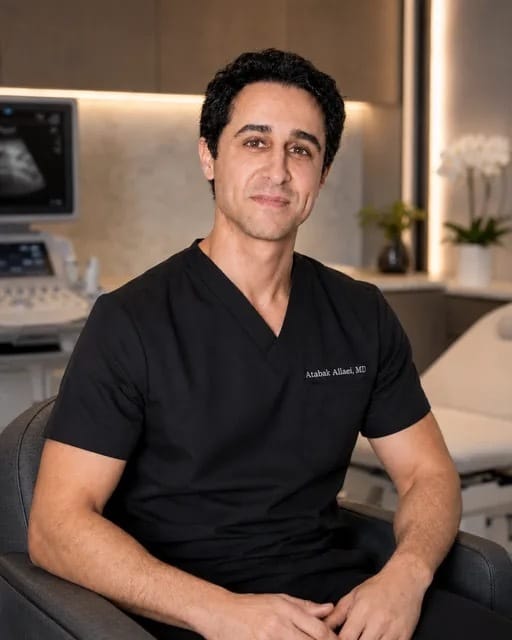

Great experience with Dr. Atabak Allaei!! I wasn't sure what to expect when I contacted this Dr's office for my fibroids, but its 6 months later and just got the news from the Dr that my fibroids are smaller than a nickel now and no longer active. I was bloated for so long and I have felt the difference lately, I would definately recommend this place!

I had an absolutely wonderful experience. After struggling since my teenage years with heavy cycles and painful symptoms caused by fibroids and adenomyosis, I was repeatedly told that my only options were birth control or a hysterectomy. Wanting another opinion, I found Dr. Allaei — and I’m incredibly grateful I did.I decided to move forward with the UFE procedure, and in my experience it was quick and minimally invasive. I only needed about one day of downtime, and although I continued taking it easy for a few days afterward, I already felt much better. Now, months later, my cycles are normal, and the pain, heaviness, and other symptoms are completely gone. I’m truly so thankful for this procedure and the positive impact it has had on my life.
Dr. Allaei is such a great doctor. I had very large fibroids and with the fibroid embolization procedure, my fibroids shrunk 40% after 6 months and will continue to shrink. I’m so happy my boyfriend found California fibroid center. I would recommend them to anyone that is going through uterine fibroids.
I had fibroids for years—big ones too—and they caused heavy periods, bloating, and constant trips to the bathroom. Every doctor I saw pushed surgery until I came across Dr. Allaei. He offered fibroid embolization as an option and I’m really glad I gave it a try. The procedure was done through a tiny puncture in my wrist, no stitches or anything. The first week after was tough (a lot of cramping and fatigue), but totally worth it. My periods have become way more manageable, and I’m no longer dealing with that daily pelvic heaviness. So happy I avoided surgery. Thanks so much!
Dr. Allaei has been incredibly knowledgeable, thoughtful, and sensitive in how he provided information about my condition and healing path. He even took the time to sit with my father and explain the procedure fully once again, so that my father, who is a doctor himself, could ask all the detailed medical questions he needed to. My procedure went off without a hitch, Dr. Allaei's team checked in on my recovery frequently and thoughtfully, and my condition has vastly improved. It feels like a miracle.
I was dealing with super heavy periods, bloating, and pressure from fibroids. Surgery wasn’t something I wanted and a lot of doctors kept pushing this. This doctor was the first one that gave me some hope. The procedure sounded terrifying but it was quick, and I was home the same day. I had cramping for a couple days, but nothing unmanageable. Bleeding is way lighter now. I’m so relieved I didn’t have to do surgery. Thanks so much!
I am 100% satisfied with Dr. Allaei. He is not only professional, knowledgeable, and very human, but he is also truly handsome. I felt cared for and reassured throughout my treatment, and I highly recommend him. Fibroid getting smaller and smaller !!
Best medical experience I’ve ever had from start to finish! I can’t say enough great things about Dr. Atabak Allaei and his team at California Fibroid Center. I’ve had major complications with myomectomies in the past, and my new doctor was recommending yet another open surgery. Determined to find a less invasive option, I did my own research and found Dr. Allaei. From the moment I met him, I knew I was in the right hands. He has a great bedside manner.Dr. Allaei is incredibly confident in his expertise—and for good reason. He assured me my Uterine Fibroid Embolization (UFE) would be successful, and for the first time in a long time, I felt hopeful. I’ve had other procedures before, but nothing compared to the level of care, detail, and professionalism I received here. His entire staff was attentive and made the process smooth and stress-free.I am beyond grateful I found Dr. Allaei, and I highly recommend him to anyone considering fibroid treatment or looking for an alternative to major surgery.
Best medical experience I’ve ever had from start to finish! I can’t say enough great things about Dr. Atabak Allaei and his team at California Fibroid Center. I’ve had major complications with myomectomies in the past, and my new doctor was recommending yet another open surgery. Determined to find a less invasive option, I did my own research and found Dr. Allaei. From the moment I met him, I knew I was in the right hands. He has a great bedside manner.Dr. Allaei is incredibly confident in his expertise—and for good reason. He assured me my Uterine Fibroid Embolization (UFE) would be successful, and for the first time in a long time, I felt hopeful. I’ve had other procedures before, but nothing compared to the level of care, detail, and professionalism I received here. His entire staff was attentive and made the process smooth and stress-free.I am beyond grateful I found Dr. Allaei, and I highly recommend him to anyone considering fibroid treatment or looking for an alternative to major surgery.
After years of fibroids making my life miserable—heavy bleeding, back pain, constant bathroom trips—I finally looked into other options. Dr. Allaei explained UFE really clearly. This was my 3rd consultation and I was considering surgery ablation and the UFE. This made the most sense as I had a lot of fibroids and they wanted to do hysterectomy. Recovery was a few days of rest and cramping, but it’s been totally worth it. I feel like I got control of my life back. Thanks so much!!!